Improving bus networks
Marseille, Allauch, Plan de Cuques and Septèmes les Vallons
Marseille, Allauch, Plan de Cuques and Septèmes les Vallons : “Pluses on the buses”
An ambitious approach to modernizing the bus network.
The bus network of Marseille, Allauch, Plan de Cuques and Septèmes les Vallons has been the subject of an improvement project initiated by the Aix-Marseille Provence Metropolis, as part of its Mobility Plan.
The ambition is clear : to increase the number of urban public transport users by 50% by 2030.
To achieve this, work was carried out to adapt the bus networks, to the urban transformations of the Marseille basin, to the new rhythms of life of residents as well as to new uses analyzed on the basis of travel flows.
The result is an improved and strengthened network with new services, new frequencies, as well as a road development program.
A network hierarchy allows everyone to better understand how services work and offers customers:
- – « lebus+» main lines which offer increased frequency and range,
- – « lebus» inter-district service lines to complete the network,,
- – « lebus proximité » shuttles to ensure very close or on-demand service,
- – And “Noctambus” night lines for 24/7 network operation.
In order to prepare for the energy transition, the bus network will be 100% electric by 2030, five years ahead of the targets set by Europe.
A consultation that has largely mobilized
Following a diagnostic and design phase, the bus network improvement project was submitted for public consultation in 2023. During this period, contributions from residents, associations, economic and institutional stakeholders were collected. The consultation was rich, thanks to everyone’s involvement, and many lessons were learned. The Aix-Marseille Provence Metropolis then carried out a significant analysis to integrate as many of these comments as possible and adjust the project to best meet residents and their expectations : adjustments to lines, routes, frequency, and timetable.
The main challenge was to improve the performance of the service to make it an even more attractive alternative to the car and to broaden the range of users.
The “most in buses” project is being rolled out
Since the summer of 2024, the Aix-Marseille-Provence Metropolis has been implementing the “more on buses” project in Marseille, Allauch, Plan-de-Cuques and Septèmes-les-Vallons.
More services, better regularity, extended timetables… The Aix-Marseille-Provence Metropolis has started improving its bus network 6 months ahead of the initial schedule.
In order to support changes in habits, allow everyone to take ownership of the project and carry out appropriate road developments, the new bus network will then be rolled out gradually until 2030. In total 90 bus lines will make up the future Marseille bus network.
The first developments for 2024/2025 concern around twenty lines.
Since summer 2024
Extended evening hours
7 lines have had their evening timetables extended : lines 19, 23, 72, 83, B1 and B2 operate until 1 a.m. all year round, and line 20 until 11 p.m. in June, July and August.
A new on-demand shuttle service, line 59, to La Garde Hill is available in the evening. Departing from the Vieux-Port, it serves the Vauban, Endoume, Saint-Victor, Bompard, and Roucas Blanc sectors, from 9 p.m. to 1 a.m., every 30 minutes, every evening.
A night network to the campuses
In addition, a night network, called « Noctambus », operates to the campuses. The service operates three nights a week, on Thursdays, Fridays, and Saturdays. Departing from the Vieux-Port, from 1:30 a.m. to 4:30 a.m., line N1 serves, among other things, la Timone and Luminy, and line N2 serves Saint-Charles, Saint-Jérôme and the Château Gombert technology park.
What's new in 2025
Many other improvements have emerged since 2025.
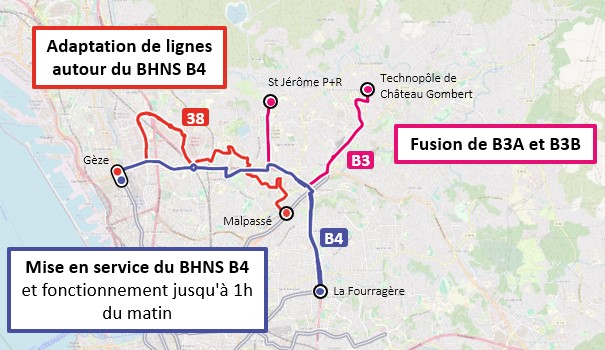
Increased services in the city centre, two new lines on the L2 and the Southern Urban Boulevard, new services around the B4 BHNS and tramway extensions are being prepared to facilitate travel.
BHNS B4 – Marseille
Extension of tram line T3 north/south (December 2025)
Arenc – Gèze
Castellane – La Gaye
Adjustment of 6 bus lines around
Arrival of 75 electric buses
To support the energy transition, 75 new electric buses will join the 21 buses already in operation, bringing the total to nearly 100 electric buses this year. Each year, new buses will be deployed in conjunction with the modernization and electrification work at Marseille’s bus depots, with the aim of reaching 100% of the fleet electrified by 2030.
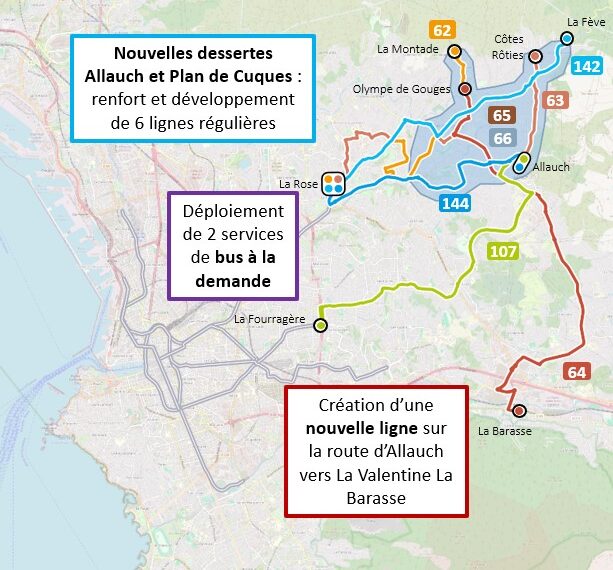
- A new network for Allauch and Plan de Cuques from summer 2025
The municipalities of Allauch and Plan de Cuques benefit from a completely reorganized bus network with much more frequent services, new lines and connections to new destinations such as La Valentine, La Barasse, Le Technopole de Château Gombert, La Fourragère or the Montecristo high school.
- Increase in supply: +50%
- Lines operate continuously all day long
- Line 144 extended in the evening until 1 a.m.
- + buses on weekends and during holidays
- New connections to Marseille Barasse Station, La Valentine, La Fourragères Metro Station, Chateau-Gombert Technology Park
- improved passenger information
La Ciotat/Ceyreste : a new network
Launched in 2021 with the adoption of the Local Mobility Plan, the network overhaul came into effect on July 7. This highly anticipated transformation marks a major development for this dynamic region, whose transportation network had not undergone significant changes for several decades.
Beyond better aligning transportation options with current travel needs, the new network is clearer, more balanced, accessible, and modern. It strengthens service to key amenities such as the train station, the hospital, the Eden Theater, and the Ancre Marine commercial area, as well as strategic neighborhoods such as the city center, the iconic natural sites of Mugel and the Calanques, the Athélia business parks and shipyards, not to mention residential areas such as Fardeloup.
A hierarchical network for an offer adapted to needs and neighborhoods
-
- • A network backbone line that connects the station to the city center
- • Complementary lines to finely mesh the territory
- • A line dedicated to the commune of Ceyreste and its connection with La Ciotat
- • Two Transport on Demand (TAD) including one already existing in Athélia (with expansion of range) and a new one in Ceyreste
The new Ciotabus network now offers
- • A main line operating 7days a week, every 15 minutes during peak hours
- • Extended hours from 6 a.m. to 7 p.m. continuously on all lines, including Transport on Demand (TAD)
- • Operation of all lines from Monday to Saturday + 4 lines on Sunday
A strengthened connection with the rest of the Metropolis
- • Reinforced service to the SNCF train station with 3 lines and 2 on-demand transport (TAD)
- • Intermodality reinforced by the creation of the Deruy Multimodal Exchange Hub (PEM), which will eventually house a P+R (Park and Ride), a bus station and all the functionalities of an exchange hub.
Improved accessibility and network modernization
-
- • The upgrading of around thirty additional stops, in addition to the 42 new stops created (target of 110 stops in the medium term)
• The gradual deployment progressif of a clean fleet, with 4 standard electric vehicles to start with
- • Replacement of furniture at stops for more intuitive and harmonized passenger information
Cassis: Shuttles reorganized
To support the changing demand for mobility in Cassis, Carnoux-en-Provence and Roquefort la Bédoule for both residents and visitors, work has been carried out to reorganize the shuttles.
New lines
The new services, which came into operation in July, improve access to Cassis train station and the Gorguettes car park, making it easier to travel around the town without a car.
From now on, four bus lines will be available to the public:
- 371: Cassis Station – Casino Town Center
- 372: Gorguettes car park – Casino City Center
- 373: Cassis station – Gorguettes car park – Presqu’ile (in season)
- 374: Cassis train station – Industrial zone – Roquefort la Bédoule
An offer adapted to seasonality
These lines are gradually reinforced during the season to adapt to the crowds, whether during the holidays, during the May bank holidays or during the summer period.
Electric buses
The energy transition is also underway in Cassis. This year, three electric minibuses were put into operation to ease traffic in the city center.
A bus on demand
To complement the services offered by the 3 new lines, an on-demand bus system (line number 376) is available to the public to make journeys in less dense areas or areas not covered by regular lines.
School services
Continuing the work undertaken on shuttles, school services S400, S401, S403, S404, S405, S406, S407, and M9 will also benefit from adaptations to better accommodate student numbers and school service. The new maps and timetables will be available very soon.
Aubagne : a restructured network
Following the reorganization of the networks in Marseille and La Ciotat, and in line with the metropolitan objective of increasing public transport ridership by 50% by 2030, the Aubagne bus network is undergoing changes.
The overhaul of the Aubagne bus network, along with its renumbering, is scheduled for the start of the 2026 academic year.
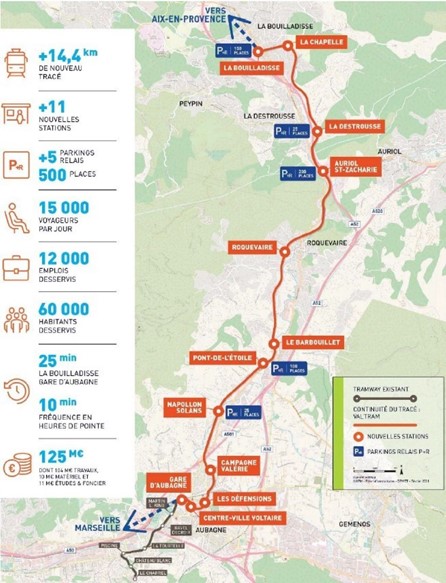
A thorough study will allow for the adaptation of the Aubagne (Aubagne) and Cigales (Gémenos) bus lines to the needs of residents and the specific characteristics of the area. This overhaul will also coincide with the arrival of the ValTram tramway, which will connect the Aubagne Multimodal Transport Hub (PEM) to neighboring northern municipalities, extending as far as La Bouilladisse.
In the spring, a consultation was organized to allow residents to express themselves and enrich the project.
lebus+, a high-level bus service (BHNS)
Lebus+, High-Level Bus Service (BHNS)
Bus Rapid Transit services (BHNS) are bus lines optimized to offer a high-performance alternative to traditional public transportation. They benefit from dedicated infrastructure, such as dedicated lanes, modernized stops, and priority at traffic lights, ensuring greater regularity and significant time savings for users.
The ambition of the Aix-Marseille-Provence Metropolitan Area is to develop an efficient and structured BHNS network, improving travel flow while promoting sustainable mobility. Thanks to their high frequency, extended timetables and increased comfort, these buses provide an alternative to private cars and contribute to reducing greenhouse gas emissions.
lebus + from Miramas
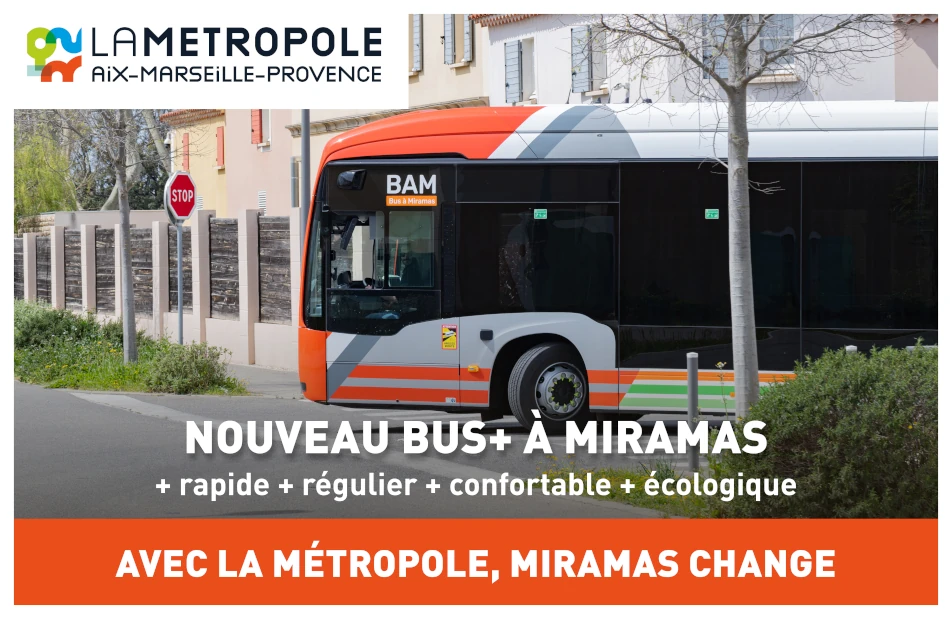
Lebus+ à Miramas, called “BAM”, or Bus+ in Miramas, replaces line 10. It is a High Level Bus Service (BHNS) line.
Since April 2025, it has offered a more efficient public transport alternative that is better suited to users’ needs.
+ fast
+ regular
+ comfortable
+ ecological
Connected to the Lebus and Lecar lines, and the Miramas SNCF train station, it connects Avenue Jean Moulin to the Village de Marques in just 18 minutes. Connected to the Lebus and Lecar lines, and the SNCF train station, the BAM offers a modern, fast, and comfortable alternative to private cars.
From 6 a.m. to 9:30 p.m., the BAM offers increased frequency (every 10 minutes during rush hour) and smooth traffic flow.
For more information about this project, click here.
Aubagne's Lebus+
The “Bus à haut niveau de service (BHNS)“, between Aubagne train station and Plaine de Jouques (Gémenos), will be operational from September 2025. This new line replaces the former line 1 of the Aubagne urban network. It follows a 6.5 km route serving the multimodal transport hub at Aubagne train station, the Camp de Sarlier and Les Paluds business parks, the La Martelle shopping area, and the Plaine de Jouques business park in Gémenos.
For more information, click here.
Lebus+ from Marignane, Vitrolles and Pennes Mirabeau
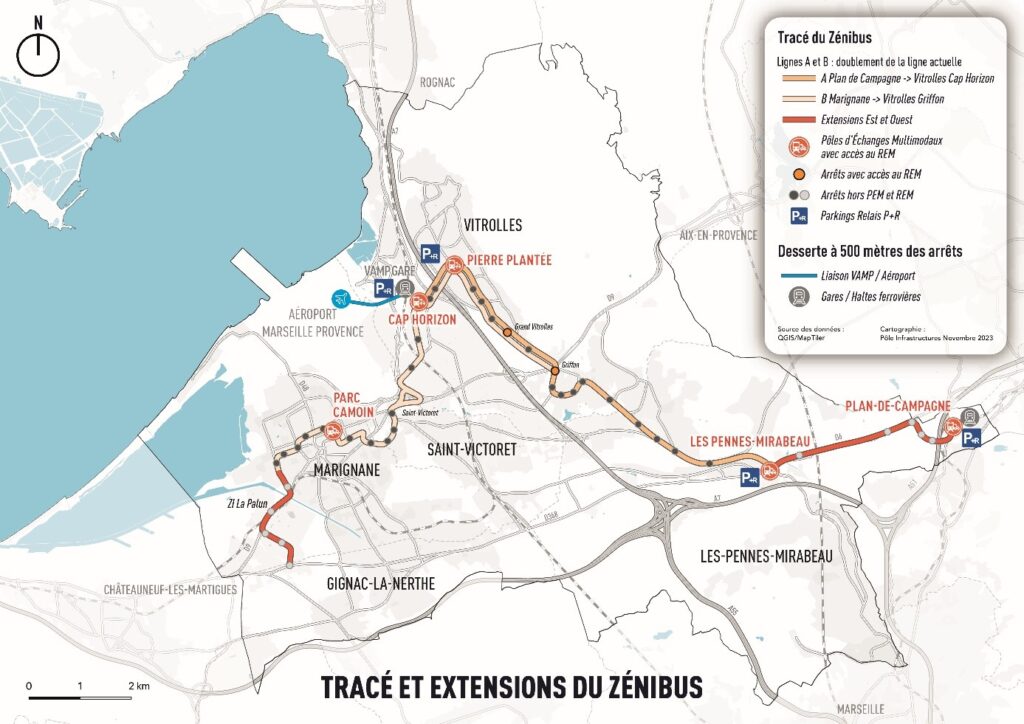
The ZENIBUS is a “Bus à Haut Niveau de Service (BHNS)” connecting the towns of Marignane, Saint-Victoret, Vitrolles, and Les Pennes-Mirabeau over a total distance of 17 kilometers. It serves key areas such as the Estroublans business park, the Pierre Plantée bus station in Vitrolles, and the Florides Technoparc in Marignane. It splits the former line into two new, separate lines: ZEN A and ZEN B.
These two lines share a common 4-kilometer section in the municipality of Vitrolles, including seven stations and three interchange hubs. This configuration allows for increased frequency, with a train every five minutes during peak hours on this segment.
For more information about this project, click here.
Lebus+ B4 in Marseille
As part of its mobility plan, the Metropolis put into service in September 2025 a new Bus Rapid Transit (BRT) line in Marseille.
Named “B4”, it links the Capitaine Gèze multimodal interchange hub to the La Fourragère hub, thus connecting the north and east of the city.
With a potential of 30,000 passengers per day and more than 45,000 residents served, this new bus line will become the busiest in the RTM network.
Thanks to the creation of this new line, which is faster (27 minutes for 8 km), more regular, more comfortable and more ecological, the Metropolis will reduce car traffic in the area by around 2,500 vehicles every day.
This operation also creates “active” traffic spaces: cycle paths, bicycle parking, pedestrian walkways, large quiet spaces, planting of 250 trees along the route.
From the Gèze interchange hub, approach corridors at intersections have been created up to the A7 motorway. The BHNS uses the lanes created as part of the surface improvements to the L2 ring road, between Sainte-Marthe and Saint-Jérôme.
Special feature of this line: it runs in the Montolivet tunnel, on the L2, from Frais Vallon, to exit at the Saint-Julien interchange.
It then continues its route along dedicated lanes to the La Fourragère interchange hub
Lebus+ of Aix-en-Provence
Deployment of 18-meter vehicles.
Trams
Marseille: Extension of the Gèze Tramway
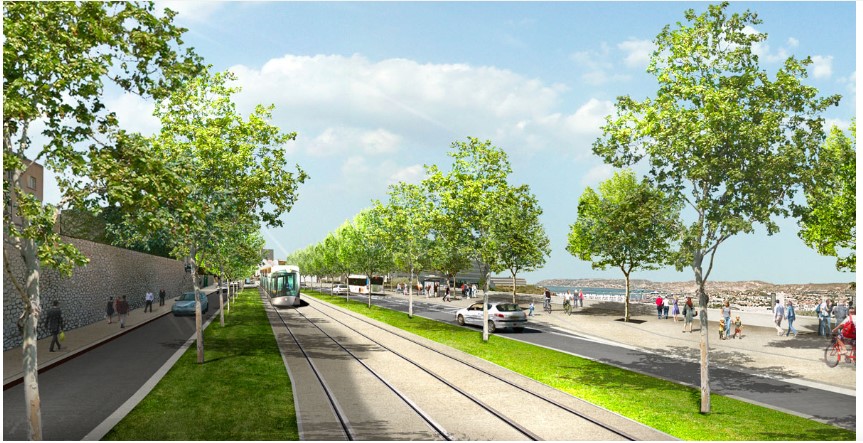
The Marseille tramway extension to Capitaine Gèze, scheduled for late 2025, is a major component of the city’s north-south tramway network expansion project. This first phase aims to improve urban mobility by connecting key areas of the city. The northern extension stretches 1,8 km, connecting Arenc to Capitaine Gèze and including three new stations.
©STOA
For more information about this project, click here.
Marseille: Extension of the La Gaye Tramway
The Marseille tramway extension to La Gaye is a major project aimed at improving mobility in the city’s southern districts. This extension, scheduled for late 2025, will stretch 4,4 km, connecting Place Castellane to La Gaye, located near the southern hospitals. It will include nine new stations, providing better access to residential areas and business hubs in southern Marseille.
For more information about this project, click here.
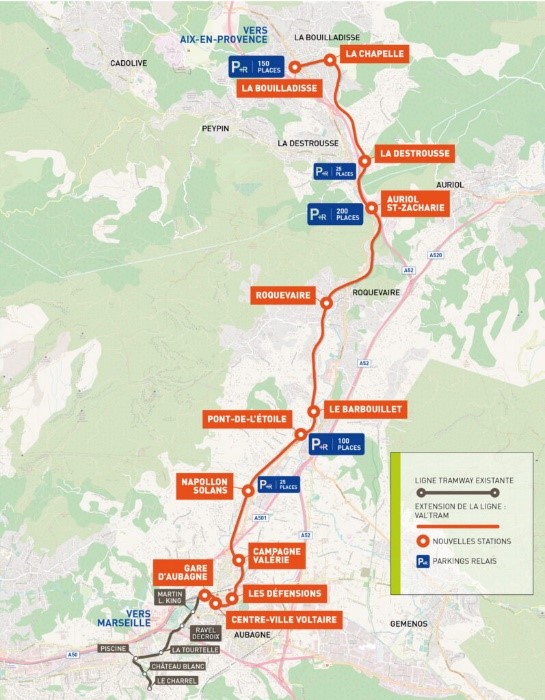
La Bouilladisse, La Destrousse, Auriol, Roquevaire and Aubagne: The Val Tram
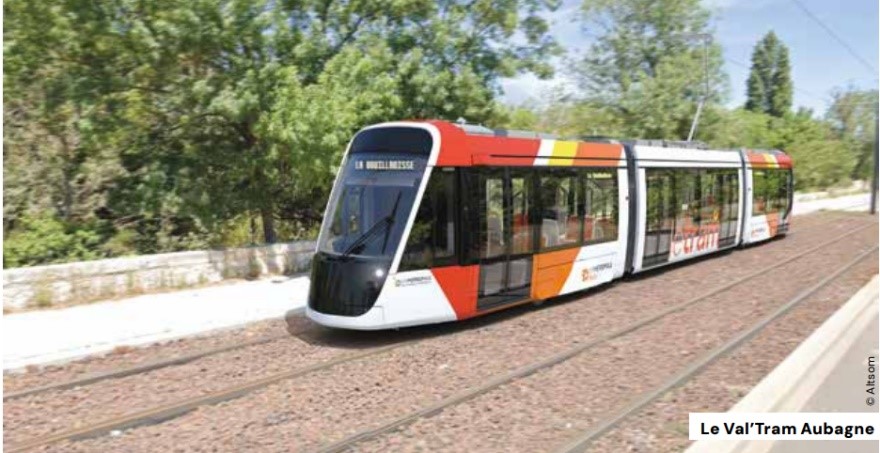
The Val’Tram project involves extending the existing tram line in Aubagne, in the Huveaune Valley, to La Bouilladisse by 2026. The project will follow the former railway line, known as the Valdonne line, for 13.2 km. The necessary utility relocation work in Aubagne for this project began in 2023. It will serve five municipalities (La Bouilladisse, La Destrousse, Auriol, Roquevaire, and Aubagne).
For more information about this project, click here.
Multimodal Exchange Hubs (PEM)
Multimodal interchange hubs (PEM) are infrastructures designed to facilitate connections between different modes of transport, such as buses, trains, bicycles, and cars. They aim to improve intermodality, i.e., the seamless transition from one mode of transport to another, by offering services adapted to user needs : bus stations, park-and-ride facilities (P+R), secure bicycle spaces, etc.
The Cap Horizon Multimodal Interchange Hub in Vitrolles
As part of its mobility plan, the Aix-Marseille-Provence Metropolis is planning the development of several Multimodal Interchange Hubs, including the Cap Horizon hub in Vitrolles. It will include a bus station with a 250-space park-and-ride facility. A landscaped esplanade, lined with shops and office buildings, will connect the bus station to an inclined elevator equipped with two cabins, providing a direct connection to the Vitrolles Aéroport Marseille Provence station (VAMP).
©STOA
The Saint Antoine Multimodal Interchange Hub in Marseille
The renovation of the Multimodal Interchange Hub, in Marseille’s 15th district is part of the Plan d’Aou / La Viste urban renewal program. It will provide access to Saint-Charles train station in less than 10 minutes. The Multimodal Interchange Hub is currently being modernized, made safer and expanded with :
• A 137-space parking lot,
• Five bus bays at the Multimodal Interchange Hub and two BRT bus bays on Avenue Saint-Antoine,
• A shade structure,
• A room for bus drivers,
• Two retention basins.
The Lamanon Multimodal Interchange Hub
Work on the future Lamanon multimodal interchange hub (PEM) will begin in July.
Located near the Lamanon SNCF train station, the future PEM aims to strengthen the attractiveness of public transport and facilitate the 6,000 daily journeys made by local residents. To this end, the multimodal interchange hub will be served by bus line 13 (Lamanon-Alleins bus station). Accessibility for cyclists and pedestrians will also be improved, with direct access from the bus stop, as well as a secure bicycle station, to encourage soft mobility. This PEM will benefit the residents of Lamanon, but also residents of neighboring municipalities, particularly Eyguières, Alleins, and Mallemort.
Preservation and enhancement of Lamanon’s natural environment
The project involves the creation of a 49-space park-and-ride facility, including 14 pre-equipped to eventually accommodate electric vehicle charging stations (IRVE), and two reserved for people with reduced mobility (PRM). A drop-off area will complete the offering for greater flexibility.
The PEM is scheduled to be commissioned by the end of the year.
The Camp Sarlier Multimodal Transport Hub in Aubagne
Park and Ride
Sainte Marguerite Dromel in Marseille
In September 2025, the Aix-Marseille-Provence Metropolis reopened the Sainte-Marguerite Dromel park and ride (P+R) located in the heart of the resort.
The Sainte-Marguerite Dromel P+R facilitates intermodality. Directly connected to the M2 metro line and to buses 15, 15S, 16S, 24, 46, 48, 73, and soon to the T3 tramway, it constitutes a true multimodal hub, reinforced by the presence of a maintenance and storage site (SMR) intended to receive the new tramway trains.
The objective is clear: to simplify access to the city center and encourage the use of public transport.
Ability :
• 600 spaces for light vehicles,
• 101 spaces for motorized two-wheelers,
• 44 spaces reserved for carpoolers,
• 38 spaces equipped with electric charging stations,
• A secure bicycle shelter with 80 spaces nearby:
La Boiseraie in Marseille
With a capacity of 70 seats, its opening is planned for 2026.